Hanno Millesi
Zeitgeist. An essay.
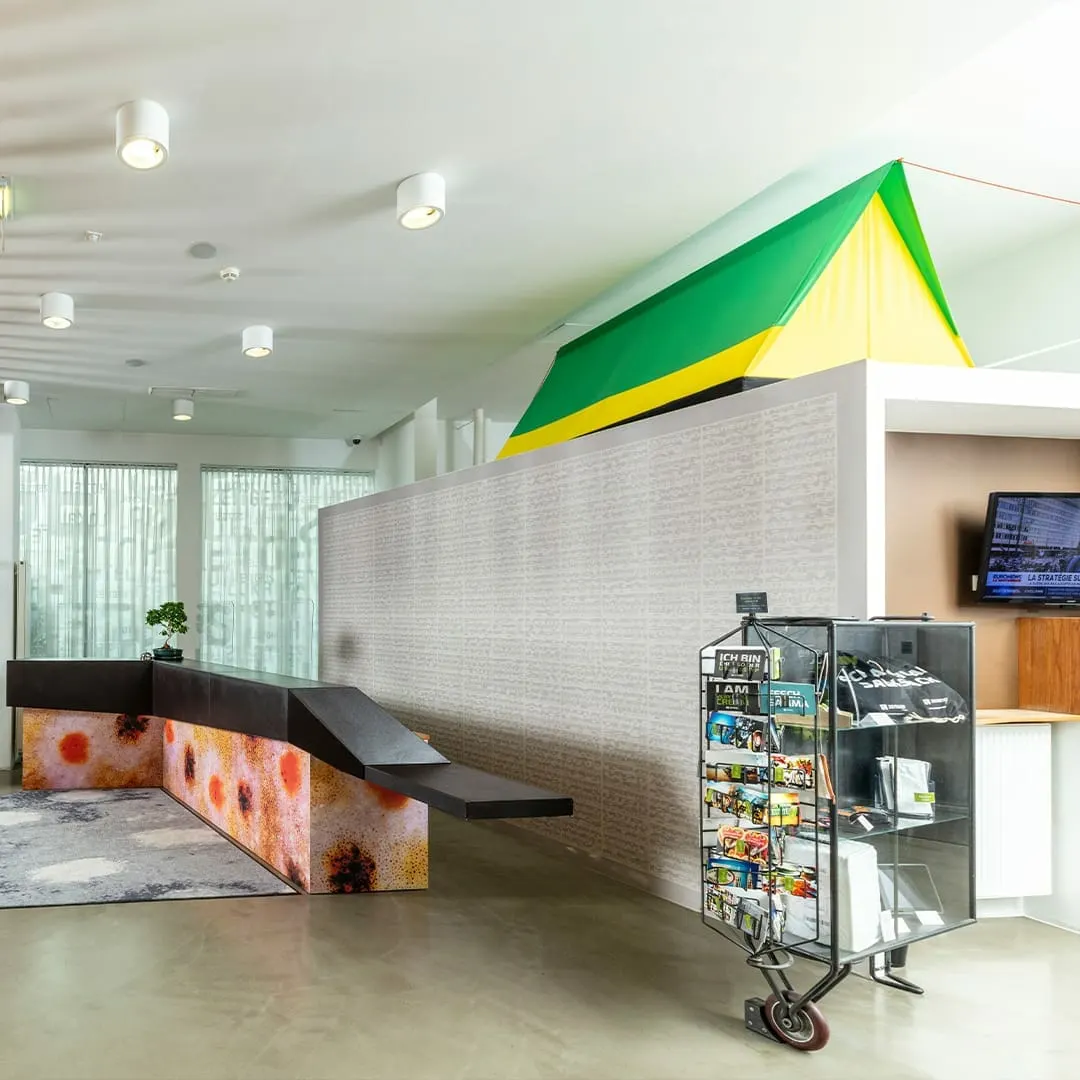
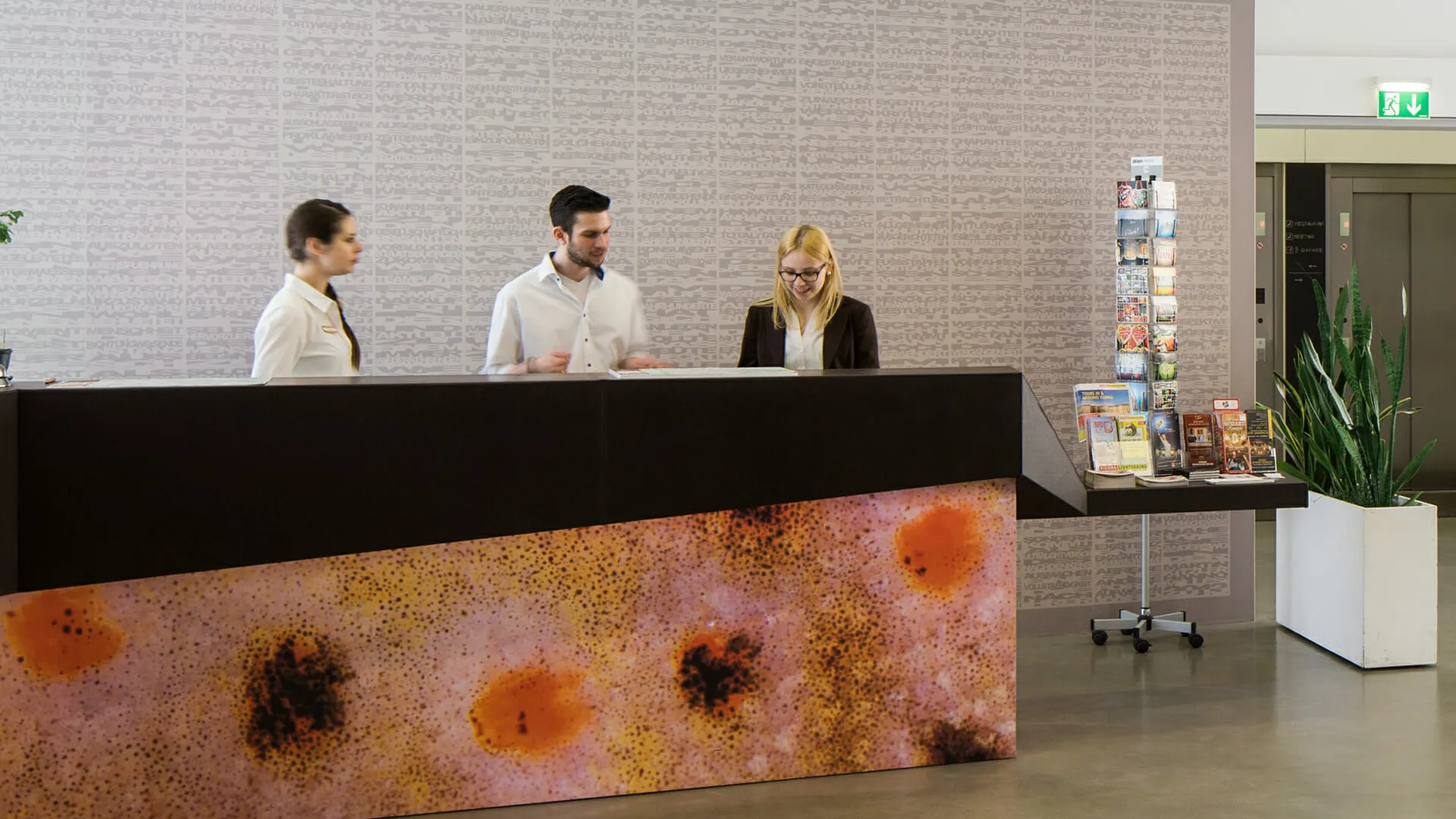
On the idea of Zeitgeist and on the hotel: 1,524 words. Six of them appear in each of the 254 room mirrors; the whole text is on the wall behind the front desk.
Ever since humans have understood themselves to be responsible for all discoveries and inventions, and in equal measure for the catastrophes that break over them, one of their most pressing concerns has been to find out how, and by what means, the course of time might be influenced by them. If they play a decisive part in shaping its character at any given moment, they prove themselves ideal contemporaries. After all, a good deal goes back to their predecessors and should be taken into account with a view to those who come after. A stability like that of repetition circling around itself is nothing for time or for humans, since men and women are creatures who demand a little more than a mere glance at their behavior if they are to be understood correctly. A contradiction like the one between existence and the ceaseless reflection on that very existence, on the other hand, exerts an irresistible attraction on humans. Contradictory, because thoughts of this kind change one’s own presence, and with it the subject of the entire exercise in thinking, and keep dispatching the idea of a final insight into the unattainable. Every added observation turns the existence of the observer into one that did not exist in that form before. Even the supposed grasp of one’s own situation can therefore last only for a while, flash up for a moment, while new conditions are already crystallizing. A ceaseless becoming that spurs on to ever new enthusiasm, yet adds a sense of powerlessness to moments of insight. A powerlessness in the face of the unstoppable nature of this change, which goes back to humans themselves, but whose consequences they can influence only sparingly. They take on responsibility and in the same moment recognize their powerlessness to follow the condition they have conjured up with one that suits their ideas. This applies in particular to the individual within the crowd, to the person as a component of society. This multitude has taken on special significance ever since the study of the past stopped focusing exclusively on the broad strokes of world events and began to pay attention to private life as well.
The search for the mindset that goes with a particular epoch reaches back a good two hundred fifty years. At the time, it grew out of the effort to get hold of the character of a certain stretch of time by means of specific criteria. That inevitably led to the question of who was entitled to set such criteria, to determine which traits, which patterns of behavior ought to be called symptomatic. After all, this treats a single group, along with its airs and mannerisms, as representative of all humankind. Ever since, certain camps have repeatedly taken it upon themselves to proclaim their worldview as the one that is truly decisive and, proceeding from it, to demand a contemporary layout of probity and integrity.
It is no accident that ideas of this kind were, and still are, discussed above all in one region of the world, whose inhabitants traditionally regard themselves as the epitome of progress and as the measure of their own species. True to the supposed character of our time, such a claim to primacy is no longer made explicit today, and when it is, it is played down with the argument that it belongs to primal human needs, indeed that it fundamentally conditions humans, ego included, in the first place. I am what the time is. My behavior should prove itself adapted to whatever sets my time apart from earlier times. Time, however, turns out to be an infinitely varied development that emerges out of itself. Where an overview is lacking, categorization steps in. An impulse for this may have come from how we deal with the arts. There, correspondences were noted whose further development at times proceeded almost in lockstep. The fact that such parallels were tied to the strict dictates of a relatively small group was not given enough weight. Nor was the limited reach of the media compared with today, whose limitlessness is currently among the socially explosive topics.
Flawed assessments of this kind have contributed to the dubious image that clung to a term like Zeitgeist for centuries. Religion, totalitarian systems, the male sex, all the way to an economy geared toward general prosperity, which we supposedly now represent ourselves: behind it there is always a system whose agenda includes sounding out the supposedly right attitude toward the now and, derived from it, a contemporary way of behaving. What the life of the true believer looks like, how the subject is supposed to behave, what duties fall to the citizen, who is a team player and what a patriot ought to feel. Today, for instance, the consumer is expected to display the kind of willingness to cooperate that benefits every me within the us and may prove an advantage to all those who follow in our footsteps.
For our ancestors, by contrast, it seemed beyond question that a fate of humankind tied to time had to be finite. From a beginning whose roots reach back into a mystically embellished primal state, well protected, if at times severely tested, into a future designed by a higher authority. A hint of this lies in the classification, still common today, into terms like primeval times, early times, modern times and the like. Over the centuries, however, science has shed everything metaphysical and pulled technology, with its regularity, over human coexistence like a cover. Since modernity, humans seem to have arrived in the now; their own expectations have been caught up with, and hopes for a higher essence have been given up for the time being. From that moment on, it falls to humankind to bring forth the guiding authority from within itself. Humans begin to understand that terms like now, at this moment and current belong to a moment that keeps recurring, not to a specific stretch of time whose perpetual revival should be their concern. Today moves to the center as soon as it is recognized that the course of time, if it cannot be determined, can at least be changed. From then on, the past serves analysis with a view to the present, and the future in turn serves a conceivable outlook. Modernity gets studded with prefixes, while the classic is understood as a high point that keeps returning. Such an understanding stands behind strategies like collage, remix or sample. Insights of the kind that overtake those who no longer simply endure, but take part, who co-create instead of limiting themselves to the role of spectator.
To linger in what is passing is possible only for those who understand their life as a state of ceaseless becoming. As coming and going, return, departure, now and then running late. A recurring leaving of home in order to find shelter, in the meantime, in a not-home. That is the spirit of the traveler, for whom, on the road, one glance at their own time follows another, each lasting as long as a flash without a camera. And the hotel is such a not-home. A place to recover from the trip in the middle of the trip, from where a glance at what is passing can succeed. The hotel as the place where people of the most varied origins, cultures, intentions and pasts come together and spend time without meeting one another. They have made arrangements, yes, but not with one another: each has arranged to meet someone from the front desk. They are passing through, on their honeymoon, here for a few days to do business or to see a sight. Together, and yet unaware of one another, they fill their lodging with their plans, perspectives and prospects, which could not be more individual in their variety. They cross paths as soon as they leave their rooms. Rooms that treat them, as guests, essentially all the same, regardless of who pays the bill. They walk a stretch of the way together down the hallway, wait next to each other for the elevator, pick up scraps of conversation that, torn out of context, at best yield a new meaning of their own, owed to the moment. They themselves contribute such scraps of conversation to the general incomprehension.
In the breakfast room they sit table by table, help themselves at the same buffet, each in a way all their own. In the breakfast room, vows of love are renewed and contracts lined up, a quarrel is picked, a presentation is skimmed one last time, a child’s fear of a sightseeing tour is soothed in vain. From the outside, the hotel is a state: architecture, an address, an offer on the internet. Where it shelters people who meet with a care that other people bring to life, this state becomes a function. Like ephemeral phenomena such as the Zeitgeist, the hotel is never whole for a single moment but, thanks to the constant change inside it and to the many individuals who together make up guests and staff alike, a continuous becoming. Coming and going, leisure, livelihood. Past, present and future flow into one another. While the last night of one stay sets in, the booking for the next few days comes through. Upstairs, two prefer to point out their temporary unavailability, while downstairs someone arrives earlier than expected. The beds may be fully occupied, the kitchen and room service working at capacity. The hotel is fully present, if at all, only in fleeting instants, in the awareness of individuals. As a fiber of that inspiration one brings home from a trip, though it is usually traced back to goals reached, memorable ceremonies or the odd quirk. Zeitgeist, as it makes its rounds in a hotel, serves no one as a means of oppression. Instead, as an ultralight version of reflecting on existence, it comes close to a unique snapshot, of a kind rarely found elsewhere in society.
The few words, the fragment of a sentence that guests find in their room, that they do not overhear through the wall, that is relayed to them neither by telephone nor by television, but that they read where they catch a glimpse of themselves, are meant to remind them of the larger context of which they are individual elements. To take it all in will never be possible for them, though it is they who make it complete in the first place. A completeness that will be a different one after they have left.
Hanno Millesi
The essay in the hotel
Where to find the text at Zeitgeist Vienna.
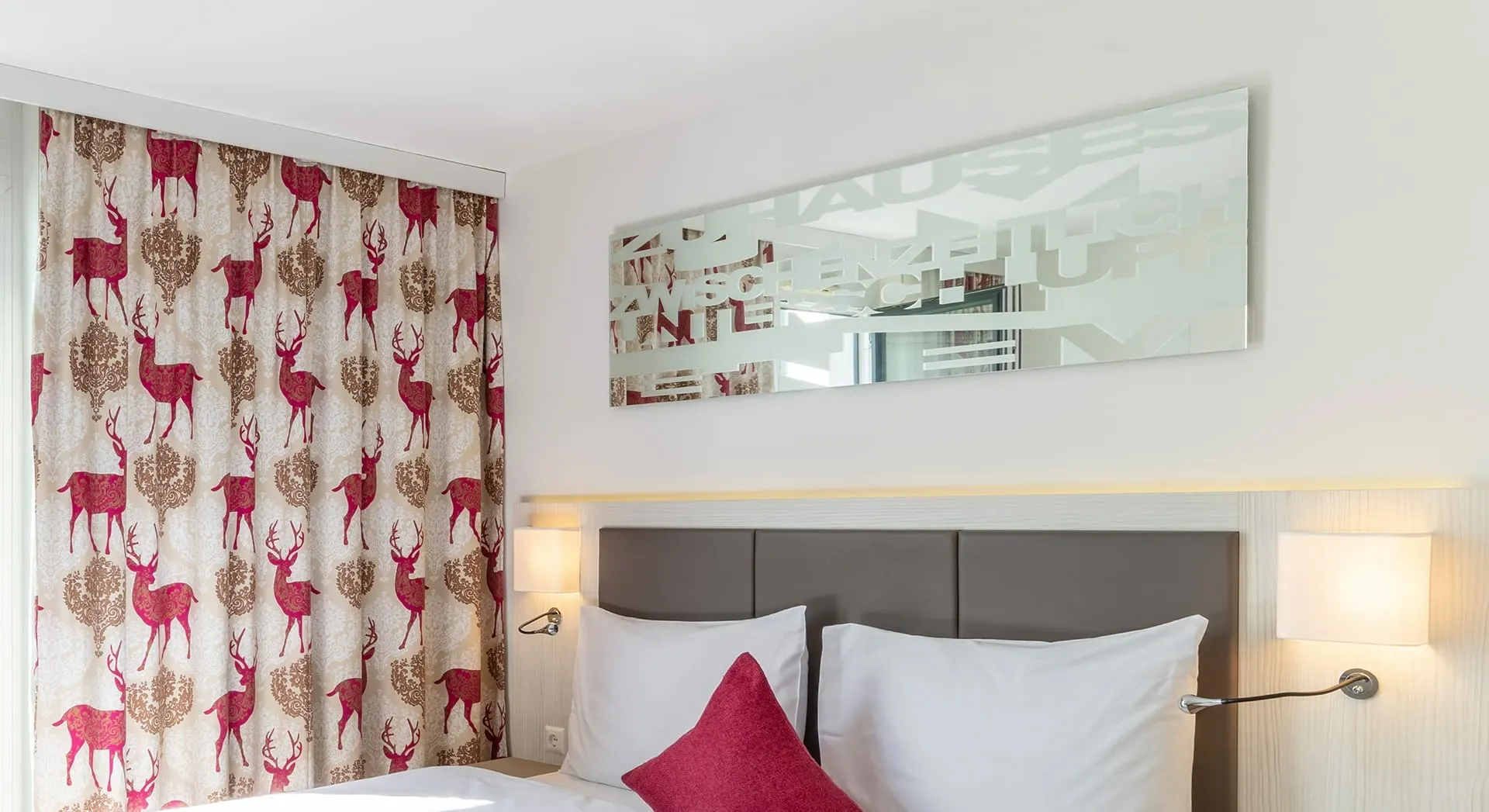
No 05 · Essay in the mirror
254 rooms, one mirror per room, six words per mirror, framed by Martin Kitzler.
Read more →No 12 · The essay on the back wall
The whole text is on the wall behind the front desk, set in rectangles like the cubbyholes that held the old room keys.
Read more →